China Top Gel Nail Polish Set Supplier for Global Buyers?
China has become a major sourcing base for professional and consumer nail products. Its manufacturers offer UV and LED formulas, private labeling, packaging customization, and flexible order quantities. For global buyers, a reliable Gel Nail Polish Set supplier must provide more than attractive colors. Consistent curing, stable viscosity, accurate labeling, and documented quality controls matter equally.
Industry data supports this opportunity. Grand View Research reports continued growth in the global nail polish market, driven by salon services, at-home beauty routines, and product innovation. Fortune Business Insights also identifies rising consumer interest in long-wear and quick-drying nail products. These trends create strong demand for complete sets with base coats, color gels, top coats, lamps, and application tools. Still, market figures vary by research method. That difference deserves attention.
A professional Chinese supplier should explain its testing process clearly. Buyers should request ingredient specifications, batch records, safety data sheets, curing instructions, and packaging samples before placing large orders. ISO 22716-based manufacturing practices can support better cosmetic quality management. Suppliers should also help buyers review market-specific labeling requirements, including rules in the European Union, United States, United Kingdom, and other destinations. Compliance is not a marketing slogan. It requires evidence.
Small details reveal factory experience. Does the brush close cleanly? Does the color match the approved sample after curing? Does the bottle leak during transport? These questions matter. A low quotation may hide weak testing or unstable raw materials. No supplier can promise universal compliance without reviewing the destination market. For global buyers, the best Gel Nail Polish Set partner combines competitive production with transparent documentation, responsive communication, and the humility to improve when testing exposes a problem.
China’s Role in the Global Gel Nail Polish Set Market
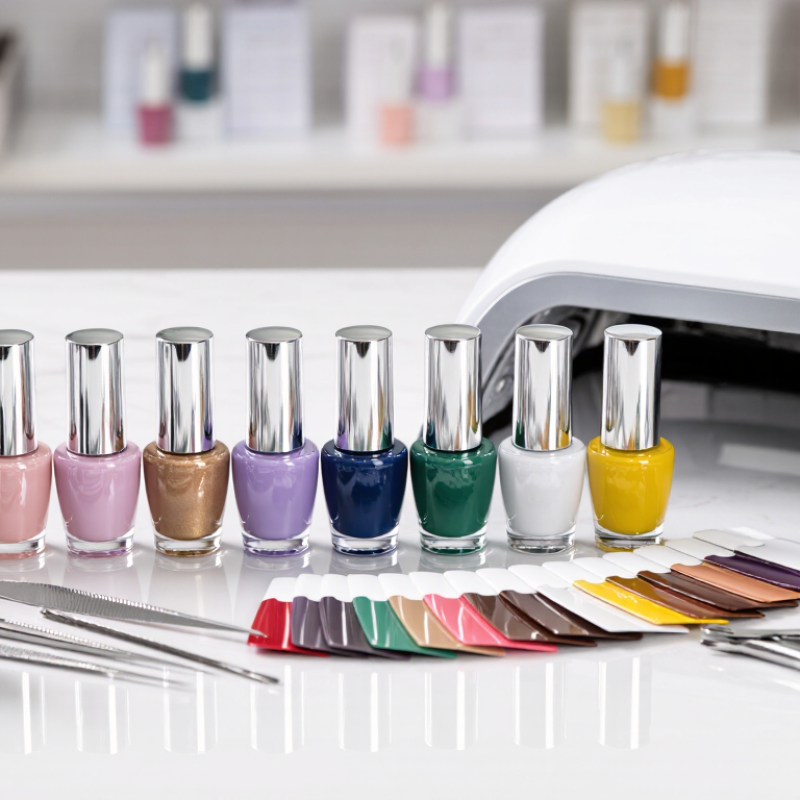
China has become a major production base for gel nail polish sets sold worldwide. Its strength comes from integrated supply chains, covering gel formulation, color development, packaging, and assembly. Buyers can often source base coats, color gels, top coats, lamps, and tools from one manufacturing region. This reduces coordination time, but it does not remove quality risks.
Reliable suppliers usually maintain batch records, viscosity checks, pigment consistency tests, and curing evaluations. During sourcing, buyers should request samples from different batches. Observe the brush shape, bottle seal, odor, curing time, and removal performance. Small details matter. A gel that cures unevenly can create customer complaints and higher return costs.
China’s export role is also changing. Manufacturers increasingly support customized colors, flexible packaging, multilingual labels, and market-specific documents. However, compliance requirements differ across countries. Buyers should verify ingredient disclosures, safety documents, labeling rules, and lamp compatibility before placing large orders. Factory audits can reveal practical issues, such as dusty filling areas or weak carton protection. These problems are easy to overlook in online negotiations. Low prices may appear attractive, yet inconsistent color matching can damage a retailer’s credibility. Even experienced buyers sometimes approve samples too quickly. A stronger process includes written specifications, retained samples, pre-shipment inspection, and clear responsibility for defects. This makes China’s supply network more dependable for global gel nail polish set distribution.
Key Product Types and Formulation Features
For global buyers, a reliable gel nail polish set supplier should offer clear product categories, not a crowded catalog. A practical starter set may include base coat, color gels, and glossy or matte top coat. Professional kits can add builder gel, soak-off shades, and magnetic effects. Mini sets suit sampling and travel retail. Salon bulk sets need consistent filling and lot tracking. Small details matter.
Formulation features determine application, wear, and removal. A balanced base coat should level smoothly without flooding the cuticle. Color gel needs dense pigment, controlled viscosity, and even curing under compatible LED or UV lamps. Top coats should resist scratches while preserving shine after repeated hand washing. Builder gel requires structure and workable self-leveling properties. Low-odor systems may improve the working environment, but odor alone does not prove quality. Buyers should request ingredient documentation, curing guidance, stability data, and batch samples.
From supplier evaluations, brush shape and cap torque often affect salon speed more than expected. A 9–12 mm brush can support neat coverage, but preferences differ. Test three coats on artificial tips and natural nails. Check wrinkling, tackiness, color shift, and removal time. A sample may look perfect on day one and fail after two weeks. That is easy to miss. Compare warm and cool storage results, because transport conditions vary across markets. Some formulas still need refinement. Honest technician feedback can reveal problems that laboratory checks overlook.
Manufacturing Standards and Quality Control Processes
China Top Gel Nail Polish Set Supplier for Global Buyers?
Manufacturing Standards and Quality Control Processes
Reliable gel nail polish production begins with controlled raw materials. Experienced factories check pigment purity, polymer quality, and packaging compatibility before mixing. Each incoming lot receives a code for traceability. Small details matter.
During production, technicians monitor viscosity, color consistency, filling volume, and mixing temperature. Samples are tested for adhesion, curing response, surface smoothness, and removal performance. A controlled lamp test can reveal uneven curing within minutes. Operators also inspect bottles, brushes, caps, and labels for visible defects.
Quality control continues after filling. Finished sets should pass leakage checks, drop tests, and accelerated stability reviews. Retained samples help compare future batches with approved standards. Records should show test dates, equipment settings, operator names, and corrective actions. This evidence supports clearer communication with global buyers and helps suppliers meet applicable market requirements.
No factory process is perfect. A reliable supplier admits occasional variation instead of hiding it. If one shade becomes thicker, the team should investigate storage temperature, pigment dispersion, and filling speed. Corrective action may require reformulation or additional testing. That takes time. Buyers should request inspection reports, safety documentation, batch samples, and clear acceptance criteria before placing large orders. Consistent results come from disciplined systems, not attractive packaging alone.
How Global Buyers Evaluate and Select a Reliable Supplier
Global buyers evaluating a China gel nail polish set supplier need evidence, not attractive catalog images. A professional review starts with product samples, complete ingredient information, and consistent batch documentation. Ask for SDS, COA, curing instructions, shade charts, and packaging specifications. Check whether the formula performs under the lamp used in your target market. A sample may cure well once and fail later. Test several batches. Small details matter. Inspect brush alignment, cap sealing, odor, viscosity, and label readability. Record results with dates and lot numbers. This creates practical traceability when questions arise.
Reliability also appears in daily communication. Request a written quotation showing MOQ, lead time, payment terms, carton size, and replacement procedures. Suppliers should explain quality checks before filling, labeling, and shipment. Ask how they control color variation between batches. An on-site or independent factory audit can verify equipment, storage conditions, and production capacity. It is not perfect. Still, it reveals gaps that a video call may hide. Buyers should confirm export packaging and documentation for each destination, because cosmetic requirements differ by market. Do not accept vague promises.
A capable supplier should support controlled customization without losing formula consistency. Discuss private packaging, barcode placement, sample approval, and change-notification procedures. Keep approved samples and signed specifications. They become useful reference points during disputes. Price deserves attention, but an unusually low quote may reflect thinner packaging, unstable pigments, or weak testing. That assumption can be wrong, so verify it with records and repeat samples. A reliable partnership grows through transparent evidence, responsive corrections, and realistic delivery commitments.
How Global Buyers Evaluate a Reliable Gel Nail Polish Supplier
Quality and regulatory compliance usually receive the highest priority, followed by formula consistency, delivery performance, production capacity, and commercial terms. Global buyers commonly verify product samples, SDS and INCI documentation, batch COAs, packaging quality, lead times, MOQ flexibility, and communication before placing repeat orders.