Leave Your Message
-
Phone
-
E-mail
-
Whatsapp

Choosing the right Gel Polish supplier in 2026 takes more than comparing prices or browsing polished product photos. A dependable partner should offer consistent color, clear product information, and realistic delivery estimates. Details matter. A shade that looks warm on a screen may appear cooler under salon lighting, so samples are worth testing before a large order.
Look closely at how the supplier describes its formulas, application steps, curing requirements, and storage guidance. Request current technical documents and check that product names and batch details are easy to follow. Test several shades on actual nail tips, noting coverage, brush control, curing performance, and how the finish wears. These observations help separate useful evidence from broad marketing claims. They also reveal where your own expectations may need adjustment.
Reliability extends beyond the bottle. Compare minimum order quantities, production timelines, packaging protection, and how quickly the supplier answers practical questions. Ask what happens when a shipment arrives damaged or a shade differs from the approved sample. Communication is a real test. A supplier may have an impressive catalog yet struggle to explain a delayed order clearly. No supplier is perfect. The goal is to find one whose quality checks, documentation, and service fit your business, then verify those promises with samples and small initial orders. This guide outlines the questions that can make that choice more informed and less dependent on guesswork.
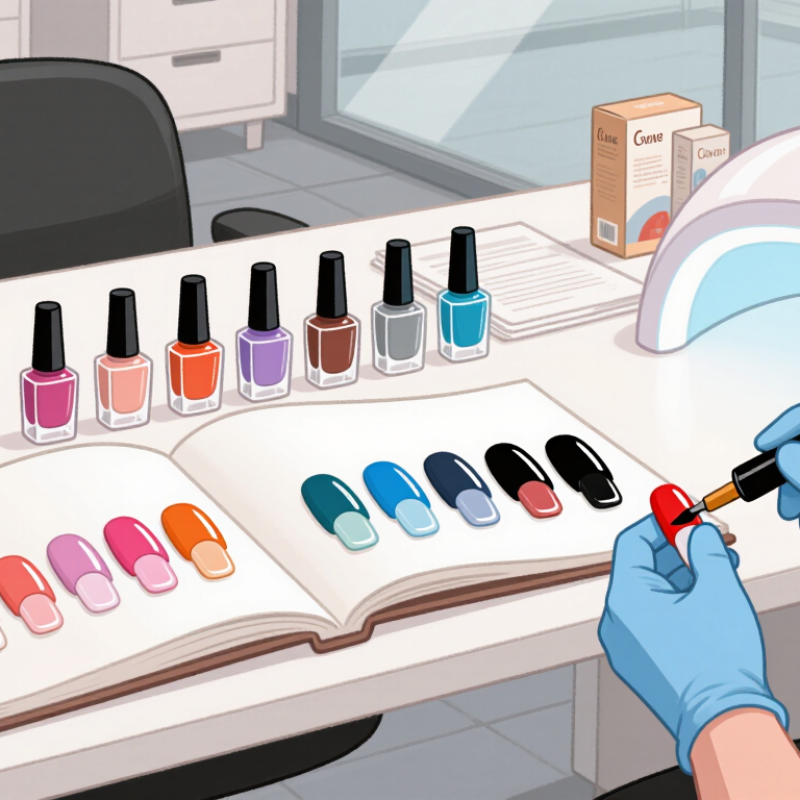
Start with actual use. Is the gel polish intended for busy salons, home users, or a focused shade collection? Each audience changes the product brief. Salons may value fast application, reliable opacity, and brushes that reach close to the cuticle. A small retail line may need compact bottles, clear labeling, and shades that photograph consistently. Specify the finish, expected wear, removal method, viscosity, and preferred bottle size before requesting quotes. Details matter. A sheer nude and a highly pigmented dark shade can behave differently during application and curing.
Write down your business limits, too. Set a target cost, estimated opening order, launch date, and acceptable minimum order quantity. Ask suppliers for samples, ingredient information, and available test or quality-control records. Test several shades on the same nail tips, using the lamp and application steps your customers will actually use. Check whether coats level smoothly, cure evenly, and remove as expected. Record your observations. It is easy to over-specify packaging before confirming the formula fits your market; I would revisit that decision after sample testing. A practical brief helps suppliers answer with comparable details instead of vague promises.
| Requirement Area | Define Your Needs | Useful Planning Baseline | Questions and Evidence to Request | Business Impact |
|---|---|---|---|---|
| Target customer and sales channel | Identify whether products are for professional salons, home users, distributors, or private-label retail. | Set separate requirements for salon-use products and consumer retail, including instructions, packaging, and support. | Ask for the intended user, recommended application process, usage instructions, and any channel-specific product documentation. | Clarifies product positioning, packaging choices, compliance tasks, and the level of technical support needed. |
| Product range and finish | List the products you need, such as base coat, color gel, top coat, builder gel, or specialty finishes. | Define each product separately by finish, opacity, viscosity, removal method, and intended application. | Request product specifications and representative samples for every formula type rather than relying on a color chart alone. | Prevents gaps in the range and helps avoid comparing products with different functions. |
| Color and effect requirements | Specify core shades, seasonal shades, glitter or shimmer effects, and desired opacity. | Test colors on nail tips and under the lighting conditions customers are likely to use; screen for consistency between samples and production batches. | Ask how color references are controlled, how batch variation is managed, and whether pre-production samples are available for approval. | Supports reliable shade selection, merchandising, and repeat orders. |
| Curing lamp compatibility | State the lamp types and curing wavelengths used by your target customers. | Many UV/LED nail lamps use light in the 365 nm and/or 405 nm regions, but compatibility and cure time depend on the specific formula and lamp. | Request the formula’s curing instructions and test it with the exact lamp models, application thickness, and process you plan to recommend. | Reduces the risk of under-curing, service problems, and customer complaints. Do not assume all UV/LED lamps cure every formula equally. |
| Application and wear performance | Set expectations for viscosity, leveling, brush control, adhesion, flexibility, and removal. | Use a documented sample-evaluation process under consistent application and curing conditions; compare results across repeated trials. | Ask for application guidance, recommended coat thickness, removal instructions, and available performance-test methods or results. | Helps establish realistic product claims and identify formula issues before placing a production order. |
| Ingredient and allergy controls | Define ingredient restrictions, customer sensitivities, and markets where products will be sold. | Review the full ingredient declaration and applicable market restrictions. In the EU, HEMA and Di-HEMA TMHDC nail products are restricted to professional use and require prescribed warnings under applicable cosmetics rules. | Request current ingredient information, applicable warnings, and written confirmation of the product’s intended market and use. Verify requirements with a qualified regulatory professional. | Supports safer product selection, accurate labeling, and market-specific compliance checks. |
| Regulatory markets and documentation | List every country or region where you intend to manufacture, import, or sell the product. | Requirements differ by market. For example, EU cosmetics generally require a Responsible Person, a Product Information File, a Cosmetic Product Safety Report, and CPNP notification before placement on the market. US obligations under MoCRA may include facility registration and product listing, subject to applicable rules and exemptions. | Ask which documents the supplier can provide and which obligations remain with your business. Have a qualified regulatory professional confirm market-specific requirements. | Prevents the mistaken assumption that a supplier’s documents alone establish compliance in every market. |
| Safety data and handling | Determine what information is needed for transport, workplace handling, storage, and emergency procedures. | Request a current Safety Data Sheet where applicable. An SDS is a hazard-communication document and is not, by itself, proof of cosmetic product compliance. | Check that document names, product identifiers, revision dates, and supplied product details are consistent. | Improves handling and logistics planning while keeping safety documentation distinct from regulatory product files. |
| Packaging and fill size | Specify bottle material, brush type, cap, label area, color coding, and required fill volume. | Gel polish is commonly sold in small bottles, including sizes around 8–15 mL; confirm the supplier’s available formats and local labeling rules. | Request packaging samples, fill-volume specifications, compatibility information, and a review of label artwork before production. | Connects product usability and shelf presentation with packaging cost, shipping weight, and labeling space. |
| Private-label options | Decide whether you need standard packaging, custom labels, custom colors, or a fully customized formula. | Customization can add approval steps, testing, artwork work, and production time. Confirm each element separately rather than assuming it is included. | Request written details on customization scope, artwork requirements, sample approvals, tooling or setup charges, and ownership of custom materials. | Helps calculate launch costs and prevents misunderstandings about what is actually customized. |
| Order quantity and pricing | Set a trial quantity, expected launch quantity, and likely reorder volume. | Minimum order quantities and unit prices vary by formula, packaging, customization, and supplier. Compare total landed cost, not just the quoted unit price. | Request a written quotation showing MOQ, price breaks, sample charges, setup fees, payment terms, and shipping assumptions. | Shows whether the order fits your cash flow and reduces the risk of unexpected costs. |
| Production and replenishment timeline | Set your required launch date and acceptable reorder lead time. | Ask the supplier to separate sample preparation, artwork approval, production, quality checks, and shipping estimates; timelines are supplier- and order-specific. | Request a written production schedule, order status updates, and a plan for handling delays or out-of-stock packaging. | Supports launch planning and helps set realistic inventory and promotion dates. |
| Quality control and traceability | Define incoming inspection criteria and the records you need for each batch. | Agree on product identification, batch or lot coding, retained samples where available, and a process for documenting defects or complaints. | Ask how the supplier checks appearance, fill, packaging, and batch consistency, and how nonconforming goods are investigated. | Improves consistency and makes it easier to investigate issues after delivery. |
| Storage and shelf-life information | Establish storage conditions and inventory rotation practices for your warehouse and retail channel. | Follow the product’s labeling and supplier instructions. Confirm the stated shelf life or period-after-opening information applicable to the product and market. | Request storage guidance, date or batch coding details, and the basis for any stated shelf-life information. | Helps protect product quality and avoid holding inventory beyond its supported use period. |
| Supplier communication and support | Identify who will handle technical questions, document requests, order updates, and complaint escalation. | Agree on communication channels, response expectations, and the process for handling quality or delivery issues before ordering. | Ask for a named point of contact and written procedures for change notifications, complaints, and corrective actions. | Reduces delays and gives your team a clear route to resolve problems. |
Planning note: The ranges and examples above are general planning references, not universal supplier specifications or legal advice. Confirm product details, test methods, and current requirements for each destination market before purchase or sale.